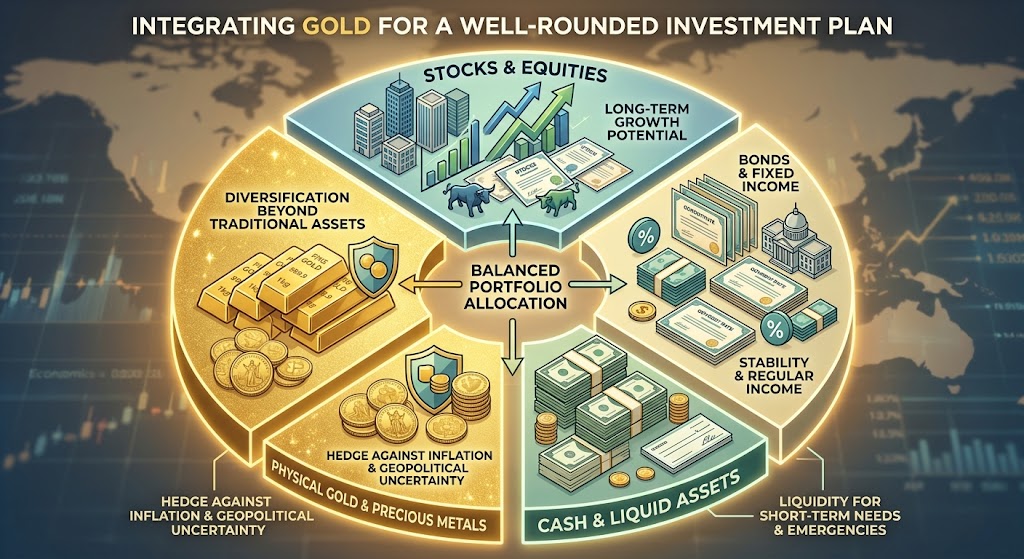
Gold can be a component of a well-rounded investment plan, particularly for people who want to diversify beyond stocks, bonds, and cash. Before acting on a market headline or a price move, investors should understand why they are considering gold, how it would affect their broader allocation, and which ownership method fits their circumstances. Educational resources from Preserve Gold can help investors begin evaluating the reasons people choose to own physical precious metals.
Table of Contents
- 1 Why Gold Is Receiving Attention
- 2 What Role Can Gold Play In A Portfolio?
- 3 Gold, Inflation, And Purchasing Power
- 4 How Gold Compares With Other Major Assets
- 5 Ways To Gain Exposure To Gold
- 6 How Much Gold Should A Portfolio Hold?
- 7 A Simple Five-Step Review Process
- 8 Common Mistakes To Avoid
- 9 Conclusion
Why Gold Is Receiving Attention
Investors often review gold during periods of market uncertainty, inflation concerns, geopolitical tension, or questions about currency purchasing power. Gold has a long history as a reserve asset, and central banks continue to hold it as part of their reserve-management strategies. The 2026 central-bank reserves survey reported that surveyed reserve managers broadly expected global central-bank gold holdings to continue increasing over the following year.
That interest does not guarantee that gold prices will rise. Many factors, including investor demand, interest rates, currency movements, economic conditions, and sentiment, influence gold. Central bank activity can be a consideration, but it should not be treated as a personal buy signal.
What Role Can Gold Play In A Portfolio?
Gold is usually best viewed as a supporting asset rather than the primary engine of long-term growth. Unlike a stock, gold does not represent ownership in a business. Unlike many bonds, it does not make scheduled interest payments. Its potential value comes from its role as a tangible, globally recognized asset that may behave differently from other holdings.
Diversification
A portfolio concentrated in a single asset class can be highly dependent on a single economic outcome. Adding a modest gold position may reduce that dependence because gold does not always move in step with stocks, bonds, or cash. Correlations can change over time; however, diversification is not the same as protection against every loss.
Liquidity And Long-Term Ownership
Widely traded bullion products and gold funds can generally be bought or sold more easily than many physical assets, such as real estate. Still, liquidity depends on the product. Physical coins and bars may involve dealer spreads, shipping, authentication, or storage arrangements, while funds and stocks can be sold during market hours at changing prices.
Gold, Inflation, And Purchasing Power
Inflation reduces what a dollar can buy over time, which is why some investors look to gold when living costs are rising. Gold has sometimes performed well during inflationary periods, but it is not a dependable short-term inflation hedge in every environment. Its price can decline even when consumer prices are increasing. Investors concerned about purchasing power can also compare gold with other approaches, including inflation-protected bonds, real estate exposure, dividend-paying companies, and maintaining an appropriate cash reserve. The useful comparison is not simply which asset had the strongest headline return, but how each choice fits within a portfolio after accounting for fees, taxes, volatility, and time horizon.
How Gold Compares With Other Major Assets
- Stocks: Often used for long-term growth and can provide dividends, but their prices may be volatile.
- Bonds: Can provide income and may add stability, although interest-rate changes and credit risk can affect their value.
- Cash: Provides ready access for spending needs and emergencies, but may lose purchasing power over time.
- Real estate: May offer rental income or appreciation potential, but can require substantial capital, maintenance, and time to sell.
- Gold: Produces no regular income, yet may provide diversification and portability for investors who want exposure outside traditional financial assets.
Ways To Gain Exposure To Gold
Physical Coins And Bars
Owning physical gold provides direct possession, but buyers should account for premiums over the metal value, delivery costs, secure storage, insurance, and dealer resale policies. Bullion products are generally easier to value and resell than highly promoted collectible coins, whose prices may depend on factors beyond metal content.
Gold Exchange-Traded Funds
Gold exchange-traded funds can offer convenient market access without requiring home storage. Investors should read the prospectus and understand the fund’s structure, expense ratio, holdings, and trading costs. Owning fund shares is different from personally holding coins or bars.
Gold Mining Stocks And Complex Products
Mining stocks can be affected by gold prices, but they are also businesses subject to operating costs, debt, mine performance, management decisions, and broader equity-market conditions. Futures and other leveraged products can magnify gains and losses, making them unsuitable for many beginners.
Retirement Account Options
Gold held through an IRA is subject to specific rules. The IRS explains that certain bullion and coins may qualify, while physical possession and other requirements can apply when metals are held in a retirement account. Review these requirements before making a retirement-account decision, and consider speaking with a qualified tax professional.
How Much Gold Should A Portfolio Hold?
There is no universal percentage that works for every investor. A suitable allocation depends on income needs, age, debt, emergency savings, investment horizon, risk tolerance, and the assets already held. A small allocation may provide exposure without allowing gold to determine the outcome of the entire portfolio. Investors should be especially careful about making a large purchase after a rapid price increase or during a period of fearful news. Deciding on a target allocation in advance and rebalancing periodically can be more disciplined than trying to predict gold’s next move.
A Simple Five-Step Review Process
- Define the goal. Identify whether gold is intended for diversification, purchasing-power concerns, or another purpose.
- Review current holdings. Consider stocks, bonds, cash, real estate, and existing commodity exposure.
- Choose the form of ownership. Compare direct bullion, funds, mining stocks, and retirement-account options.
- Calculate total costs. Include premiums, commissions, storage, insurance, fund expenses, taxes, and selling costs.
- Set a review schedule. Revisit the allocation periodically rather than responding to daily price movements.
Common Mistakes To Avoid
- Using emergency savings to buy a volatile asset.
- Assuming gold always rises when stocks decline.
- Ignoring the difference between the spot price and the actual purchase price.
- Buying collectible coins without understanding grading, markups, and resale demand.
- Overlooking safe storage and insurance for physical holdings.
- Borrowing money or using excessive leverage to gain exposure.
- Skipping a review of fees, liquidity terms, and tax treatment.
Conclusion
Gold can have a useful place in a balanced portfolio in 2026, but it is not a shortcut to dependable returns or complete financial security. Its role should be based on the investor’s goals, time horizon, liquidity needs, and overall approach to managing risk. A clear purpose, a reasonable allocation, and a realistic understanding of costs and potential price fluctuations matter more than any forecast about where gold may trade next. Investors should also consider how they plan to own it, since physical bullion, funds, and other gold-related products can involve different fees, storage requirements, tax considerations, and resale conditions. Regularly reviewing the allocation can help ensure it remains appropriate as financial circumstances and market conditions change. When treated as one part of a broader plan, gold can be evaluated thoughtfully rather than through fear, hype, or short-term market noise.